

Imagine building something worth over $2 trillion, then walking away without ever telling the world your name. Who Is Satoshi Nakamoto?… No press conference. No Nobel Prize acceptance speech. No verified Twitter account. Just silence, a nine-page document, and a trail of code that rewired how humanity thinks about money.

That is the story of Satoshi Nakamoto, the pseudonymous creator of Bitcoin, and the most celebrated ghost in modern history.
In this post, you will discover everything we know, and everything we still cannot confirm, about the person or group behind the world’s first decentralized cryptocurrency. From the Bitcoin whitepaper published on Halloween 2008, to the mind-boggling Satoshi Nakamoto net worth sitting in wallets that have never moved a single coin, to the failed attempts to reveal the Satoshi Nakamoto real face, this is the most complete biography of a person who may not even be a single individual.
Who Is Satoshi Nakamoto?
Satoshi Nakamoto is the pseudonymous name of the person, or possibly group of people, who created Bitcoin. In 2008, this entity published a nine-page document titled Bitcoin: A Peer-to-Peer Electronic Cash System, introducing an idea that would permanently alter global finance. By January 2009, the Bitcoin network was live. By April 2011, Satoshi had vanished.
That is the entire biographical record the world has been able to verify with certainty.
There are no confirmed photographs. No verified passport. No birth certificate attached to the name. The question of whether Satoshi Nakamoto is a real person, one individual, or a coordinated group of developers remains officially unanswered as of 2026.
What is not in dispute is the impact. Bitcoin today commands a market capitalization in the trillions. It has spawned an entirely new asset class. Governments have debated it in parliament. Institutional investors have poured billions into it. And at the center of it all sits a mystery so deep that HBO made a documentary about it, the New York Times sent its top investigative reporter after it, and the global crypto community still cannot agree on a single answer.
Also read: Best Crypto Apps in Nigeria Right Now (2026 Review)
The Origins: A Crisis, a Mailing List, and Nine Pages That Changed Everything
To understand Satoshi Nakamoto, you have to understand the world they entered.

It was October 31, 2008. The global financial system was in freefall. Two weeks earlier, the United States government had announced a $700 billion bank bailout under the Emergency Economic Stabilization Act. Ordinary people were watching institutions they had trusted their entire lives collapse from the inside out. Faith in centralized banking had rarely been lower.
On that exact day, Halloween, a message appeared on the Cryptography Mailing List, a digital forum frequented by some of the world’s most serious computer scientists and privacy advocates. The subject line was simple: Bitcoin P2P e-cash Paper. The opening line read: “I’ve been working on a new electronic cash system that’s fully peer-to-peer, with no trusted third party.”
The sender’s name was Satoshi Nakamoto.
The attached whitepaper outlined a revolutionary system. Rather than relying on banks or governments to verify transactions, Bitcoin would use a distributed network of computers and a cryptographic verification system called blockchain. Every transaction would be recorded permanently and publicly. No single authority could control it, reverse it, or inflate it away.
The timing was not accidental. The genesis block, the very first Bitcoin block ever mined, was mined on January 3, 2009, and it contained an embedded message: “The Times 03/Jan/2009 Chancellor on brink of second bailout for banks.” Satoshi had encoded a newspaper headline directly into the foundation of Bitcoin. It was a timestamp, yes, but it was also a manifesto.
The message was unmistakable: Bitcoin was built as an alternative to a system that had just failed millions of people.
Building Bitcoin: The First Two Years
After the whitepaper circulated, things moved fast.
On January 9, 2009, Satoshi released the open-source Bitcoin client software publicly on SourceForge. Anyone with a computer could download it, run it, and participate in the new network. Three days later, on January 12, 2009, the first-ever Bitcoin transaction took place. Satoshi sent 10 BTC to Hal Finney, a respected cryptographer and one of the earliest members of the cypherpunk movement who had downloaded the software the moment it launched.
This transaction matters beyond its technical significance. Hal Finney was not a random early adopter. He was one of the most brilliant cryptographers in the world, a man who had spent years thinking about digital cash and privacy-preserving financial systems. The fact that Satoshi chose Finney as the first recipient, and that Finney enthusiastically embraced it, gave Bitcoin immediate credibility within the community that mattered most.
Over the next two years, Satoshi remained active. They participated in forums like Bitcointalk, responded to developer questions via email, made improvements to the code, and corresponded with early contributors. Their writing showed deep technical mastery but also clear communication. They wrote in fluent English, sometimes using British spellings like “favour” or “colour,” which would later become a clue for identity investigators.
Then, in mid-2010, the activity began to slow. Satoshi handed the reins of the project to developer Gavin Andresen. In April 2011, they sent a final message: they had “moved on to other things.” Then they disappeared entirely, never to be heard from in any verified capacity again.
What Did Satoshi Actually Solve?
This is the part that often gets lost in the identity speculation: the technical achievement behind Bitcoin is extraordinary.
For decades, computer scientists had been trying to solve a problem known as the double-spend problem. In digital transactions, a file can be copied. If digital money is just a file, what stops someone from spending the same coin twice? Every previous attempt at digital cash, including DigiCash, b-money, and Hashcash, had either relied on a central server to prevent this, or failed to solve it entirely. Relying on a central server, of course, recreates exactly the problem these systems were meant to avoid: a single point of control that can be shut down, compromised, or corrupted.
Satoshi solved it with blockchain technology, a distributed public ledger that records every transaction across thousands of independent computers simultaneously. To alter any record, you would have to alter the entire chain across the majority of the network simultaneously, a computational task so expensive it is effectively impossible in practice. Each new block of transactions is cryptographically linked to the one before it, meaning tampering with historical data would require redoing all the computational work that followed, which grows more expensive every second.
The whitepaper built directly on prior cypherpunk research. It cited Adam Back’s Hashcash, which introduced the proof-of-work mechanism that Bitcoin mining uses. It referenced Wei Dai’s b-money and Nick Szabo’s Bit Gold. Satoshi was not working in a vacuum; they were synthesizing decades of cryptographic research into a single coherent, working system. What makes their contribution extraordinary is not that they invented every individual component, but that they assembled those components in a way that finally worked without any trusted third party.
The cypherpunk community, a loosely organized network of cryptographers, mathematicians, and privacy advocates that had been active since the early 1990s, had been trying to build exactly this for years. Their foundational belief was that strong cryptography in the hands of individuals could provide freedoms that law alone never could. Satoshi was the person, or people, who finally delivered on that ambition.
That synthesis, executed in nine pages and a few thousand lines of code, became the foundation of an entire industry worth trillions of dollars.
You may have missed: How to Remove Malware From your Computer in 7 steps
Is Satoshi Nakamoto a Real Person? The Identity Theories
This is the question that has consumed investigators, journalists, and the crypto community for more than fifteen years.
Based on their P2P Foundation profile, Satoshi listed themselves as a 48-year-old Japanese male, which would make them around 50 years old in 2025. Almost no serious researcher believes this. The profile detail is widely considered a deliberate misdirection. The quality of Satoshi’s English, the British spelling quirks, the time zones suggested by their online activity patterns, and the depth of their cryptographic knowledge all point toward a Western, likely English-speaking background.
The leading candidates over the years have included:
Hal Finney. The cryptographer who received the first Bitcoin transaction. He was technically brilliant, deeply embedded in the cypherpunk community, and lived in the same California town as a man named Dorian Nakamoto, which struck early investigators as suspicious. Finney consistently denied being Satoshi. He was diagnosed with ALS in 2009, became paralyzed, and passed away in 2014. Many believe Finney could not have sustained Satoshi’s workload during his illness, though some argue he may have been Satoshi before the disease progressed.
Nick Szabo. The computer scientist and legal scholar who proposed Bit Gold in 1998, a concept so close to Bitcoin it is difficult to call it a coincidence. Stylometric analysis of his writing has identified strong similarities to Satoshi’s prose. Szabo has denied being Satoshi multiple times.
Adam Back. The inventor of Hashcash, whose work is directly cited in the Bitcoin whitepaper. In April 2026, New York Times investigative journalist John Carreyrou, the reporter who broke the Theranos scandal, published a major investigation identifying Back as the most credible Satoshi candidate, citing stylometric analysis, behavioral similarities, and timeline overlaps. Back, who is currently the CEO of Blockstream, has denied the claim.
Craig Wright. The Australian computer scientist spent years publicly claiming to be Satoshi Nakamoto. In March 2024, a UK High Court ruled definitively that Wright is not Satoshi Nakamoto, following a case brought by the Crypto Open Patent Alliance. The court found his claims lacked credible cryptographic proof and ordered him to retract his statements. Wright’s claims are now officially discredited.
Peter Todd. In October 2024, HBO released a documentary titled Money Electric: The Bitcoin Mystery, directed by Cullen Hoback. The film pointed to Peter Todd, an early Bitcoin developer, as a strong Satoshi candidate. Hoback’s evidence was primarily circumstantial: Todd’s technical background, his relationship with Adam Back, his Canadian origins explaining British-adjacent spelling quirks, and a 2010 forum post where Todd appeared to accidentally reply from Satoshi’s account rather than his own. Todd flatly denied it, calling the filmmaker’s case “grasping at straws.” The Bitcoin community largely agreed with Todd, and the documentary failed to produce any cryptographic proof.
The honest answer remains the same as it was in 2009: nobody knows with certainty. And many people in the Bitcoin world believe that is exactly how it should stay.
Is Satoshi Nakamoto Alive?
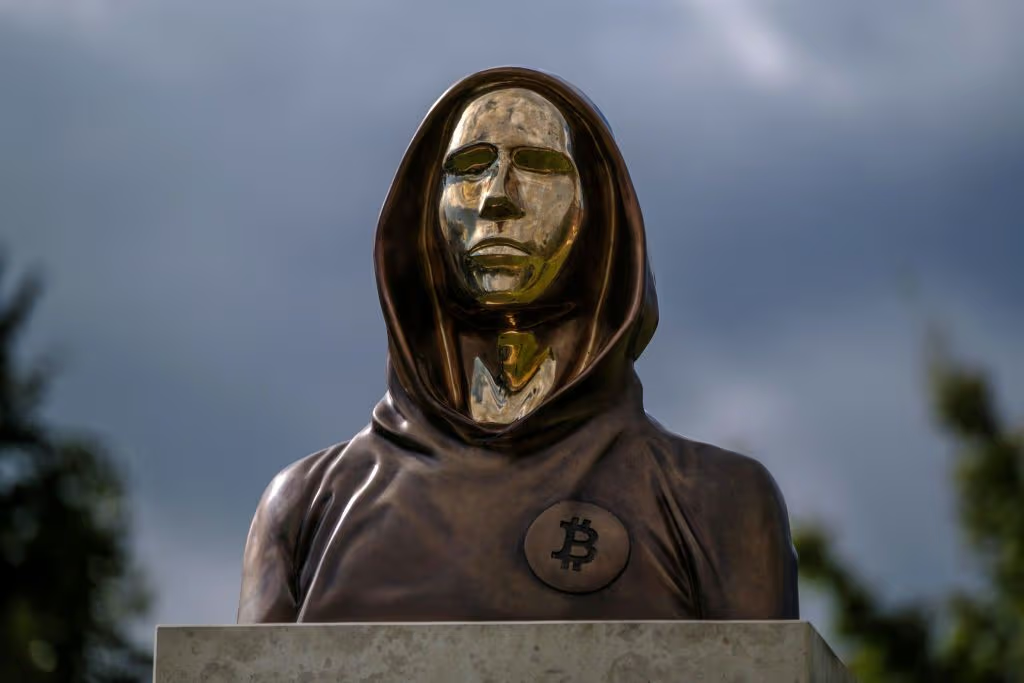
This question surfaces constantly, and the answer is: almost certainly yes, though it cannot be confirmed.
There is no credible public record of Satoshi Nakamoto’s death. The coins attributed to Satoshi have never moved. Many researchers believe that if Satoshi had died, someone, a family member, an estate executor, a trusted collaborator, would have eventually accessed those wallets or disclosed the situation. The silence of the coins is often interpreted as evidence that whoever holds those private keys is still holding them deliberately.
The coins attributed to Nakamoto, sitting untouched in wallets from Bitcoin’s earliest days, represent the strongest indirect evidence that Satoshi is still alive and still in control of their holdings. Spending even a small fraction would immediately reveal activity and likely confirm the holder’s status as the original creator. The continued silence suggests a conscious choice.
Whether Satoshi is one person quietly living a normal life, a team of developers who have gone their separate ways, or something else entirely, no one can say definitively. What the evidence strongly suggests is that whoever Satoshi is, they remain aware of their coins, aware of the world watching, and committed to staying invisible.
Satoshi Nakamoto’s Net Worth: The Billionaire Who Never Spends
Here is where the story becomes almost incomprehensible in scale.
Early analysis of the Bitcoin blockchain identified a consistent mining pattern in the network’s earliest days, a single miner who appeared to control a significant portion of early mining activity. Researchers, most notably Sergio Demián Lerner, analyzed the first 36,289 mined blocks and concluded that one miner, almost universally believed to be Satoshi, accumulated over one million Bitcoin.
Current estimates place Satoshi’s holdings at between 750,000 and 1.1 million BTC.
At Bitcoin’s all-time high above $122,200 reached in July 2025, that figure represents a fortune of over $134 billion at the top end. Even at more conservative Bitcoin prices, the Satoshi Nakamoto net worth places this anonymous figure among the wealthiest individuals on Earth, ahead of most prominent tech billionaires.
The extraordinary detail is that not a single satoshi, the smallest unit of Bitcoin named in their honor, has ever been spent from these wallets. They have sat untouched for over fifteen years. No cashing out. No moving funds between addresses in patterns suggesting spending. Complete stillness.
This restraint is itself one of the great arguments for Bitcoin’s integrity. If Satoshi had sold even a portion of their holdings at any point in the past decade, it would have triggered massive market panic and underscored fears about centralized control of Bitcoin’s supply. Their silence has been, in its own strange way, a service to the ecosystem they created.
The Satoshi Nakamoto Real Face: Why There Are No Photos
The question of the Satoshi Nakamoto real face has no answer, and that is by design.
There are no verified photographs of Satoshi Nakamoto. None. Despite being, by some metrics, one of the most consequential individuals of the 21st century, there is not a single image that has been authenticated as showing the person behind the name. Every image search for Satoshi Nakamoto returns stock photos of code, Bitcoin logos, or staged artistic portraits, none of them the actual individual.
This anonymity was clearly intentional and carefully maintained throughout the years of Bitcoin’s development. Satoshi never attended conferences. Never appeared on video. Never provided audio recordings. Every interaction was text-based, conducted through pseudonymous email addresses and forum accounts. When they disappeared, they left behind no physical trace that investigators have been able to verify.
In one sense, this is the ultimate execution of cypherpunk philosophy. The movement that gave birth to Bitcoin was always centered on the idea that privacy is a fundamental right, that individuals should be able to transact and communicate without surveillance or identification. Satoshi did not just preach this philosophy. They lived it so completely that seventeen years later, the world still cannot identify them.
Satoshi’s Legacy: What Bitcoin Became
When Satoshi mined the genesis block in January 2009, Bitcoin had no monetary value. The first commercial Bitcoin transaction, famously, involved a programmer named Laszlo Hanyecz paying 10,000 BTC for two pizzas in May 2010. Those pizzas would be worth over a billion dollars at 2025 prices.
Today, Bitcoin’s market capitalization exceeds $2 trillion. It has been adopted as legal tender by El Salvador, accumulated by sovereign wealth funds, and integrated into mainstream financial instruments including spot ETFs from BlackRock and Fidelity. Countries hold it in strategic reserves. The United States government has discussed a national Bitcoin reserve.
The blockchain technology Satoshi invented has expanded far beyond Bitcoin. Thousands of other cryptocurrencies, decentralized applications, smart contract platforms, and financial protocols trace their technical lineage back to the nine-page whitepaper from 2008.
Beyond finance, Satoshi’s design philosophy has influenced thinking about organizational structures, governance, and trust. The idea that a system can function without a central authority, maintained instead by transparent rules and distributed participation, has applications that extend into law, supply chain management, healthcare records, and voting systems.
Satoshi Nakamoto did not just create a new form of money. They introduced a new way of thinking about trust itself.
It is worth pausing on this point. Before Bitcoin, the default model for building any financial or administrative system assumed that someone had to be in charge. A bank, a government, a company. Bitcoin proved that you could build a system where the rules are enforced by mathematics and consensus, where no single participant has override authority, and where the entire history of transactions is public, permanent, and tamper-resistant. That model of trustless coordination is now influencing fields far beyond cryptocurrency, from supply chain verification to digital identity systems to decentralized autonomous organizations that operate without traditional corporate structures.
The Philosophical Dimension: Why the Mystery Matters
Many people assume that the mystery of Satoshi’s identity is a frustrating gap in the historical record. Within the Bitcoin community, the perspective is almost the opposite.
Bitcoin’s design is built on decentralization. No single person should be able to control it, manipulate it, or be pressured into changing it. If Satoshi’s identity were known, that person would immediately become a target. Governments could pressure them to alter the protocol. Regulators could subpoena them. Criminals could threaten them. Competitors could discredit them. Their mere existence as a known individual would create a single point of failure for a system explicitly designed to have none.
By disappearing, Satoshi removed themselves from the equation. Bitcoin became truly leaderless. No CEO. No founder who could be arrested and used as leverage. The protocol runs on mathematics and consensus, not on the authority or continued goodwill of any individual.
This is widely considered one of the most elegant design decisions in Bitcoin’s architecture, even if it was not explicitly planned as such. The anonymity that began as personal privacy evolved into a structural feature of the network’s resilience.
The 2025 and 2026 Developments: The Hunt Continues
The search for Satoshi Nakamoto has not slowed in recent years.
In 2025, Bitcoin surpassed $109,000 and then $122,200, reaching new all-time highs. Every time Bitcoin’s price surges, public interest in its mysterious creator spikes with it. A 2025 book, The Mysterious Mr. Nakamoto by journalist Benjamin Wallace, documented fifteen years of attempts to unmask the figure, capturing just how many investigative dead ends the story has produced.
In July 2025, a Bitcoin whale moved $8.6 billion worth of old BTC in one of the largest single-day transfers of early-era Bitcoin ever recorded, briefly reigniting speculation that Satoshi had resurfaced. Analysts ultimately concluded the transfer did not match Satoshi’s known wallet patterns.
In April 2026, the New York Times investigation by John Carreyrou raised Adam Back’s profile as a candidate higher than ever before. Back’s position as CEO of Blockstream, a major Bitcoin infrastructure company, his invention of Hashcash, his deep presence on the cryptography mailing lists where Satoshi operated, and the stylometric analysis all contributed to a compelling but still unproven case. Back denied the claims.
None of these investigations have produced what would actually close the case: a verified cryptographic signature from Satoshi’s original wallets. That proof exists. It is mathematically available. Only the real Satoshi could produce it. And so far, they have chosen not to.
Satoshi Nakamoto Timeline
| Date | Event |
|---|---|
| August 18, 2008 | bitcoin.org domain registered |
| October 31, 2008 | Bitcoin whitepaper published to Cryptography Mailing List |
| January 3, 2009 | Genesis block mined with embedded Times headline |
| January 9, 2009 | Bitcoin software released publicly on SourceForge |
| January 12, 2009 | First Bitcoin transaction: 10 BTC sent to Hal Finney |
| 2010 | Satoshi hands control to developer Gavin Andresen |
| April 2011 | Satoshi sends final message and disappears |
| 2014 | Hal Finney passes away from ALS |
| March 2024 | UK High Court rules Craig Wright is definitively NOT Satoshi |
| October 2024 | HBO documentary Money Electric names Peter Todd as suspect |
| July 2025 | Bitcoin hits $122,200 all-time high |
| April 2026 | NYT investigation points to Adam Back as leading candidate |
Final Thoughts: The Ghost Who Changed the World
There is something almost mythological about Satoshi Nakamoto. A figure who appeared at a precise moment of global financial crisis, gave the world a new system for trust and exchange, then vanished before anyone could get a clear look at their face.
Whether Satoshi is a single brilliant cryptographer, a small team of collaborators, a shy programmer living quietly somewhere in the world, or something else entirely, what they built has outlasted every attempt to define it by its creator.
Bitcoin turns 17 in 2026. Its market cap is measured in the trillions. Its architecture has been studied, forked, copied, criticized, and celebrated by thousands of developers across the world. And through all of it, the name on the birth certificate remains a pseudonym.
Satoshi Nakamoto may be the only billionaire in history whose face the world has never seen, whose voice has never been recorded, and whose legal name remains completely unknown. Yet their fingerprints are on one of the most consequential financial inventions since the paper note.
The real identity of Satoshi Nakamoto may never be revealed. But the work they left behind will not need an author’s name to be remembered.
